
Spain Won. The Americans Responded. What Did the Rest of the World See?
Friday, November 06, 2026
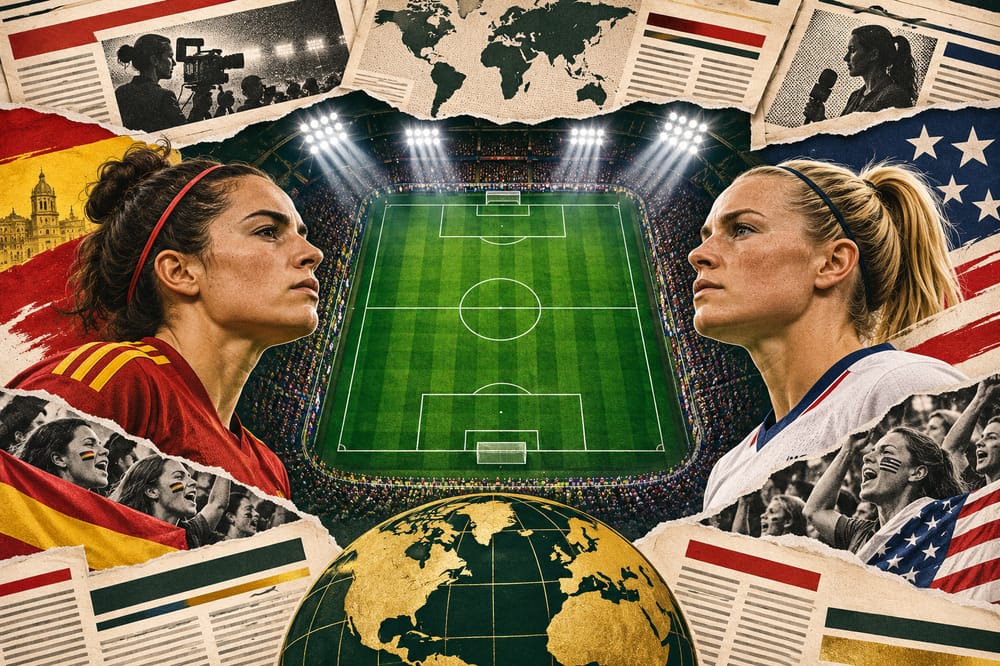
WOSO RADAR | INTERNATIONAL PERSPECTIVES | ROAD TO BRAZIL 2027
Two matches. A Spanish win. An American comeback. And plenty for both teams to sort out before Brazil.
In This Article
Spain: Winning When the Game Doesn’t Go Your Way
United States: I Like the Response. I’m Watching the Starts.
England: How Did Spain Get Those Openings?
Brazil: Two Contenders, and a Host With Its Own Ambitions
China: Ten Shots on Target. No Goals.
Japan: There Is More Than One Way to Trouble Spain
Australia: How Often Should a Team Need a Rescue?
Germany and France: What We Can Actually Say
Put the Views Together, and the Comfortable Answers Get Harder
What I’m Watching Next
Brazil Is Bigger Than This Rivalry
Sources and Further Reading
I’ll give the Americans credit for coming back against Spain.
But why did they need another comeback?
Two games. Two two-goal deficits. Against the reigning world champions, that’s a difficult way to do business.
Spain won the first match 2–0 in Washington, D.C. Three days later, the United States recovered from another two-goal hole to draw 2–2 in Chester, Pennsylvania.
The Spanish can point to an unbeaten trip. The Americans can point to their response.
Both have a case. Both have work to do.
What interests me is how the story changes when you read beyond your own country’s coverage.
Spanish reporting gives you reasons to admire Spain’s finishing and resilience. American coverage looks for evidence that Emma Hayes’s team is moving forward. An English report presses harder on the weaknesses Spain exposed. Brazilian coverage puts the matchup against the backdrop of the next World Cup.
Looking toward Asia and Australia adds more questions. What separates attacking activity from effective attacking? What can Japan’s experience against Spain tell us? And when does celebrating a team’s fighting spirit stop us from asking why it keeps needing a rescue?
Those are different ways into the same story.
And with Brazil 2027 approaching, I want to hear more than the version that makes my team look good.
Spain: Winning When the Game Doesn’t Go Your Way
Spain needed just 14 minutes to put the Americans two goals behind.
Patri Guijarro scored in the third minute. Eva Navarro added the second in the 14th.
That is a brutal opening against anyone. Against the world champions, you’ve handed yourself a long afternoon.
But Spain’s victory wasn’t a demonstration of uninterrupted control.
The Americans created chances. Adriana Nanclares had saves to make. Spain had to defend its advantage.
Mundo Deportivo gave the victory its weight while recognizing Nanclares’s contribution and the pressure from the United States. Las Futbolistas emphasized the significance of the matchup: world champions beating Olympic champions.
I understand why that matters.
Spain has earned its reputation for moving the ball, finding space, and making opponents chase. But what happens when the opponent starts creating problems of its own?
In Washington, Spain had an answer.
Take the chances. Trust the goalkeeper. Defend the lead.
You don’t get extra credit for making a win look pretty. You do need more than one way to win.
That was the encouraging part for Spain.
The second match supplied the question.
After building another two-goal advantage, Spain allowed the Americans back into the game. Ashley Sanchez scored. Mallory Swanson found the equalizer. What could have been two victories became a win and a draw.
RTVE’s broader assessment of the trip was positive, with results and opportunities for Sonia Bermúdez to assess her players.
Fair enough. Spain went home unbeaten.
But if I’m looking ahead to Brazil, I’m watching what happens when an opponent changes the game. Can Spain settle it down? Can it keep possession with a purpose? Can it stop a difficult stretch from becoming a lost lead?
Washington showed Spain could protect an advantage.
Pennsylvania showed why that still needs work.
United States: I Like the Response. I’m Watching the Starts.
There were things to like about the American performance in Washington.
U.S. Soccer’s report recorded 13 shots, including 10 on target. The team generated opportunities after Spain’s early goals.
But I’m not going to use those numbers to talk my way around a 2–0 defeat.
Creating chances matters. Finishing them matters. So does what you allow at the other end.
The Americans were chasing this game almost from the beginning.
Reuters’s coverage focused on Hayes’s belief that the team would learn from the loss. That’s a reasonable response from a coach. These are the opponents you want to test yourself against before a World Cup.
Still, I want to see where the learning shows up.
Three days later, Spain went two goals ahead again.
That’s the part that stays with me.
The Americans deserve credit for what followed. Sanchez and Swanson scored, the team kept pushing, and the second match ended level.
Those goals changed how the window felt. Two defeats at home would have left a much harsher impression.
But the comeback and the repeated deficits belong in the same conversation.
You can admire the response and question the circumstances that required it.
What I’m watching next is whether the United States can enter these games with the organization and concentration it eventually finds while chasing them.
Can the midfield protect the back line? Can the defenders manage runners and space together? Can the attack make its opportunities count before the team needs two goals just to get level?
The talent is there.
I want to see it operating as a connected team from the opening whistle.
England: How Did Spain Get Those Openings?
The English angle takes us directly into that question.
The Guardian’s report identified defensive lapses and American midfield struggles in the opening defeat.
That’s where I want to spend some time, because a scoreline tells you what happened. It doesn’t explain how the game got there.
Were players arriving late? Was there enough pressure on the ball? Were the midfield and defense close enough to help each other?
Those are the questions I’m asking when an opponent gets ahead that quickly.
We can spend hours discussing which American forwards should start. I enjoy that conversation as much as anyone.
But those forwards need a team behind them that can win the ball, keep it, and move it into useful areas.
When those connections break down, attacking talent has more work to do before it can threaten the goal.
And when the opponent is Spain, the mistakes can get expensive quickly.
What I take from that English report is a reason to look beneath the familiar discussion about individual quality.
Who helps whom when the game gets difficult?
That’s what I’m watching.
A midfielder under pressure needs options. A defender stepping toward the ball needs cover. A player making a run needs someone to recognize it.
Those relationships are part of what turns a talented lineup into a team capable of winning a World Cup.
The October series gave Hayes useful evidence about where those relationships held up—and where they didn’t.
Brazil: Two Contenders, and a Host With Its Own Ambitions
Brazilian publication Campo Delas previewed the series as a meeting between two giants of women’s football.
World champions against Olympic champions. With the next World Cup coming to Brazil, that matchup carries an obvious appeal.
Its article was published before the games, so it gives us the setting rather than a Brazilian verdict on the results.
But it also changes where we stand while watching.
From the United States, we ask whether the Americans can beat Spain.
From Spain, we ask whether the world champions remain the standard.
From Brazil, there’s another question: what will it take to beat either of them on our own soil?
Brazil has its own ambitions. It will be hosting the tournament and trying to win it.
That makes both teams worth studying.
Spain showed how quickly it could punish mistakes. The United States showed that a two-goal lead would not necessarily finish the contest.
Those are useful observations for any potential opponent.
But neither team settled the argument about 2027 in October.
There is a lot of football between a friendly in Pennsylvania and a World Cup knockout match in Brazil. Players will develop. Others will get injured. Coaches will change combinations. Tournament pressure will ask different things of everyone involved.
I see these matches as information.
Brazil and the rest of the field have reasons to pay attention to it.
China: Ten Shots on Target. No Goals.
A Chinese-language report from Qiumiwu, credited to contributor 后卫绝杀王, puts one comparison in front of us:
United States: 10 shots on target. Spain: three.
U.S. Soccer’s official account records the same figures.
The final score was 2–0 to Spain.
That gives us something worth discussing, but I’d be careful about how much we ask those numbers to prove.
They don’t tell us that the Americans deserved to win. They don’t make every attempt equally dangerous.
They do support the point that Spain had defending and goalkeeping to do.
Nanclares mattered. So did Spain’s ability to finish its early chances.
This is a statistical recap from a Chinese platform, rather than a developed Chinese tactical assessment. The interpretation here is mine.
And my question is straightforward: what turns American attacking activity into goals against the best opposition?
The United States found two answers in the rematch.
Now I want to see that effectiveness become dependable.
Japan: There Is More Than One Way to Trouble Spain
The Japanese-language preview I found on GOAL Japan treated the friendlies as an important American test before World Cup qualifying.
It was marked as translated coverage. That gives us a story available to Japanese readers, but I wouldn’t call it an independent Japanese reaction to the results.
Japan’s own experience supplies a more interesting football connection.
At the 2023 World Cup, Japan beat Spain 4–0.
The Japan Football Association’s report describes a team prepared to defend against Spanish possession and move quickly when it won the ball. Futoshi Ikeda explained the preparation behind that approach.
Japan accepted that Spain would have the ball for long stretches. It still had a clear idea of where its opportunities would come from.
That was 2023. Teams and circumstances change.
But it’s a useful reminder when watching Spain now.
Having less of the ball doesn’t mean you have to spend the match without a plan.
The connection to October is WOSO’s, rather than a Japanese media verdict on these friendlies.
Spain won in Washington without controlling every phase. Japan’s earlier victory shows another side of that relationship: Spain has also faced an opponent that defended patiently and used its attacking moments decisively.
For the Americans, I’m interested in the clarity of those moments.
When possession changes, do the players recognize the opportunity together? Is the pass available? Does the run arrive? Does the finish follow?
Those are useful questions whether you’re watching the United States, Japan, or anyone else preparing to face Spain.
Australia: How Often Should a Team Need a Rescue?
The Australian connection comes from an earlier tournament, too.
After the Matildas’ 2024 Olympic exit, ABC Sport’s Samantha Lewis examined the problems beneath the disappointment.
Australia had lost 2–1 to the United States, with results elsewhere confirming its elimination. Lewis questioned the team’s cautious approach, its reliance on desperate recoveries, and the depth and development needed to sustain success.
She was writing about Australia in 2024, not these October friendlies.
But the question her analysis raises fits here.
How often should a team need to prove how hard it can fight back?
I love a comeback. The tension, the change in momentum, the moment a game that looked finished suddenly opens up again—that’s part of why we watch.
But when you’re assessing a team’s progress, you have to look at how it keeps getting into trouble.
The Americans recovered against Spain in Pennsylvania. That matters.
They also fell two goals behind in both games. That matters just as much.
Australia’s experience gives me a reason to keep those observations together.
It also brings Spain into the discussion. A team protecting a lead needs answers when the opponent starts changing the rhythm.
Who can help settle the game? Which substitutions improve the situation? Can the team recognize what has changed and respond before the equalizer arrives?
Those are things I want to learn about both squads before Brazil.
Fighting spirit can keep a team alive.
I’m also looking for the decisions and habits that give it a stronger position to begin with.
Germany and France: What We Can Actually Say
The German-language sources located for this comparison, including Sportschau and Sky Sport Deutschland, supplied match information.
They didn’t give us enough original analysis to identify a distinct German argument about the series.
A substantive French interpretation wasn’t established in this research, either.
That doesn’t mean nobody in France covered the matches. It means I don’t have a verified French assessment to bring into this article.
I’d rather leave those places open than write what I imagine German or French journalists might have said.
The point of reading around the world is to discover another view. We need the reporting in hand to do that.

Put the Views Together, and the Comfortable Answers Get Harder
Spain can say it finished unbeaten.
The United States can say it created chances and recovered in the second game.
Both statements hold up.
Neither tells the whole story.
Spanish coverage helps explain why the world champions should be encouraged. The American accounts show why the draw felt like a response. The English report directs attention toward the weaknesses that made that response necessary.
Brazilian coverage places both teams inside a much bigger competition.
The Chinese statistical recap makes us look again at the relationship between attempts and goals. Japan’s example adds a tactical reference beyond Europe and the Americas. Australian analysis gives us a reason to question how much reassurance we should take from another dramatic recovery.
These sources serve different purposes. Some cover these games directly. Others help me ask better questions about them.
And that’s the value I want from looking beyond one country’s reporting.
I want to know what I might have missed while watching my own team.
Was I so encouraged by the comeback that I overlooked the start?
Was I so impressed by Spain’s early goals that I overlooked the work Nanclares had to do?
Did I treat a win and a draw as a complete assessment, when the way those results happened told me much more?
That’s where this series gets interesting.
What I’m Watching Next
For the United States, I’m watching the opening stages.
I want to see a team that gives itself a stronger position against elite opposition. Better connections through midfield. Clearer defensive support. Chances converted before the scoreboard starts dictating every decision.
For Spain, I’m watching how it manages an opponent’s response.
The finishing in Washington was decisive. Nanclares helped preserve the result. But the second match asks whether Spain can maintain enough control when the game begins moving away from it.
For both, I’m watching what changes between these October lessons and the next difficult match.
That’s where preparation becomes visible.
A coach can explain what the team learned. Eventually, we need to see the players solve the problem on the field.
Brazil Is Bigger Than This Rivalry
Spain went home unbeaten. The Americans showed they could fight back. Both still have work to do.
And the rest of the world is watching. Japan, Australia, Brazil, and other contenders will bring their own strengths—and their own plans for exposing those weaknesses.
I’ll celebrate the American comeback. But before Brazil, I want to see a team that can take control of these games without first falling two goals behind.
Sources and Further Reading
Mundo Deportivo — Spain’s prestigious victory over the United States
Las Futbolistas — World champions defeat Olympic champions
El País — The world’s two best teams test each other ahead of Brazil
El País — Spain’s efficiency overcomes American persistence
RTVE — Spain’s two-match tour of the United States
The Guardian — USWNT exposed by ruthless Spain
Reuters — Hayes says the US will learn from Spain defeat
U.S. Soccer — USA falls 2–0 to Spain
U.S. Soccer — USA battles Spain to a 2–2 draw
Campo Delas — United States and Spain, giants of women’s football
Sportschau — USA vs. Spain match results
Sky Sport Deutschland — USA vs. Spain match timeline
Qiumiwu — United States 0–2 Spain: match report and statistics
GOAL Japan — Spain friendlies as a test before World Cup qualifying
Japan Football Association — Japan defeat Spain 4–0 at the 2023 World Cup
ABC Sport — Samantha Lewis: Australia’s Olympic exit and the questions beneath the result
Matildas — Official account of Australia’s 2024 Olympic exit

by Tracy Brown
Stay Ahead of the Game
Women's soccer stories, match previews and analysis—delivered to your inbox.
Get notified when new stories are published. Unsubscribe anytime.
Get Our Best Selling Product!
You just read about this...
Super excited about this product? We are, too! We just wrote this whole blog post that mentions it.
Ready to buy it? Get access to the Product here: